

Since the first release of our product, I’ve spent almost all my time in a single, intense loop: talking to users, gathering feedback, and running back to the team to build improvements.
Early-stage product feedback is usually a mix of “how does this work?” and “what should I do next?”
But last week, two completely separate conversations collided, forcing us to pause and rethink our entire product strategy.
The Two Conversations
Conversation 1: The DIY User A highly technical applicant trying to navigate the complex EB-1A (Alien of Extraordinary Ability) visa process told me: “I actually don’t need a platform. I already use Claude, and I’ve built my own custom prompt setups to analyze my profile and understand my EB-1A process.”
Conversation 2: The Frustrated Attorney A few hours later, I was on the call with an immigration attorney who gave us a stark warning: “Applicants are constantly showing up to our offices sharing raw, unstructured feedback and massive text dumps generated by raw LLMs. It’s a mess. It’s ungrounded, chaotic, and it actually creates more work for us to clean up than if they had started from scratch.”
The Internal Huddle
I immediately called an internal team meeting. I laid out these two pieces of feedback on the board and asked a fundamental question:
“If anyone can open up a raw LLM and write their own prompts, how do our AI agents work differently? What actually makes our platform the differentiator?”
We didn’t talk about UI design or simple feature requests. Instead, we realized that this is the exact boundary where a feature ends and a true product begins.
It comes down to a simple analogy we’ve been using internally: The AI model is just the engine. The real product is the car.
Why a Raw LLM on Its Own Fails
If you put a Formula One engine on the floor of a garage, it is incredibly powerful. But nobody can actually drive it. Without steering, brakes, a transmission, sensors, and a dashboard, that engine can’t take you to your destination.
When users try to manage a complex legal journey like immigration using raw, generic LLMs, they are trying to steer a raw engine on the floor.
Here is exactly where a specialized agentic platform makes the difference:
1. From “One-Shot” Chats to Continuous Case Reasoning
Immigration is not a collection of twenty isolated prompt-and-response tasks. It is a long, evolving journey. An applicant’s record is never a frozen snapsho because they publish new papers, get new citations, or receive media coverage over six months. A raw LLM cannot remember or reason across this evolving timeline. Our system utilizes an agent harness that continuously tracks changes, analyzes the delta in evidence, and guides the user step-by-step from uncertainty to filing readiness.
2. The Premium of Traceability over Cheap Text
Generative AI has made producing persuasive text incredibly cheap. But in law, cheap text without proof is dangerous. Anyone can prompt Claude to write a beautiful letter. I use beautiful letter because it is easy now to find out whether AI writes a letter or you do. Nobody should judge the applicant on that particular matter. As long as letter is useful and it convey the matter well. Thats enough. But our platform builds text from the ground up using a structured evidence-backed case model. Every claim must trace backward:
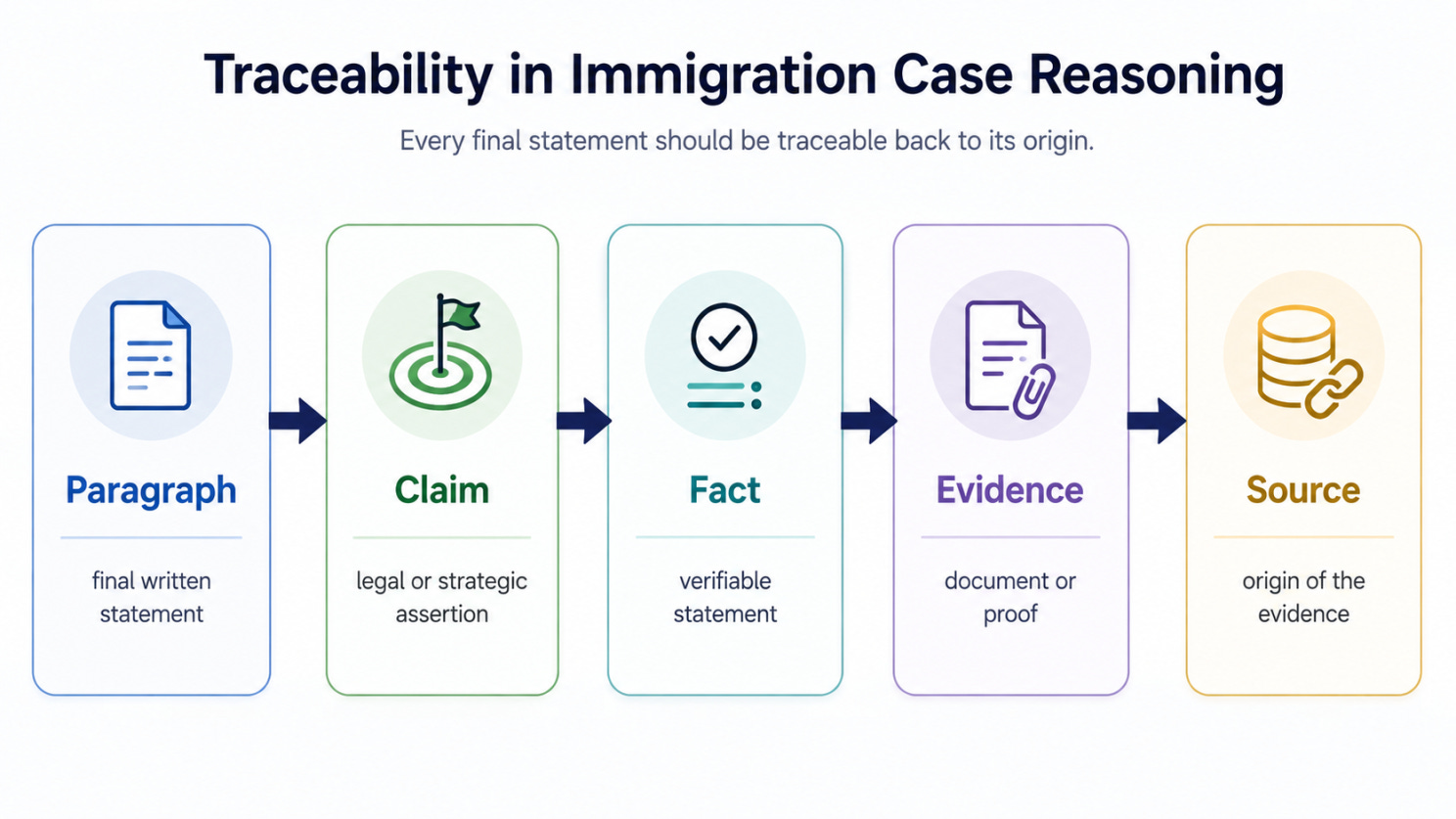
Our agents ensure that nothing is hallucinated, and every statement is anchored to real, physical evidence.
3. Protecting the Human Decision Loop
A raw LLM will confidently spit out strategic advice, even if it’s legally flawed. But legal strategy requires human judgment. Our agent harness is designed to enforce attorney approval gates. Gating process, Instead of bypassing the lawyer, our platform gives attorneys a collaborative workspace where they can see the exact reasoning behind the case and modify or approve the strategy before a single draft is generated.
The Differentiation Is in the Architecture
This is where every AI platform will ultimately make its mark.
In the near future, the underlying AI engines (Claude, OpenAI, Gemini) will become highly capable, interchangeable commodities. Asking “which model do you use?” will be the wrong question.
The winning products will be defined by the proprietary architecture surrounding the intelligence:
The way claims are represented.
How the system maps the relationship between facts and evidence.
The sequence in which autonomous agents coordinate with each other.
The strict approval gates and state tracking that guarantee compliance.
We walked out of that meeting with absolute clarity. Our job isn’t to build a better prompt. Our job is to build the vehicle that safely moves people from uncertainty to their destination.
Because ultimately, people don’t buy engines. They buy a car to get where they need to go.


