

When USCIS Says Your Evidence “Cannot Be Considered Probative”: Certified Translations, Legibility, and the Hidden Trap of 8 C.F.R. § 103.2(b)(3)
Every year, thousands of otherwise strong immigration petitions are weakened — or denied outright — not because the underlying facts were insufficient, but because the evidence was packaged incorrectly. One of the most common and most avoidable examples appears in Requests for Evidence (RFEs) and denial notices in language like this:
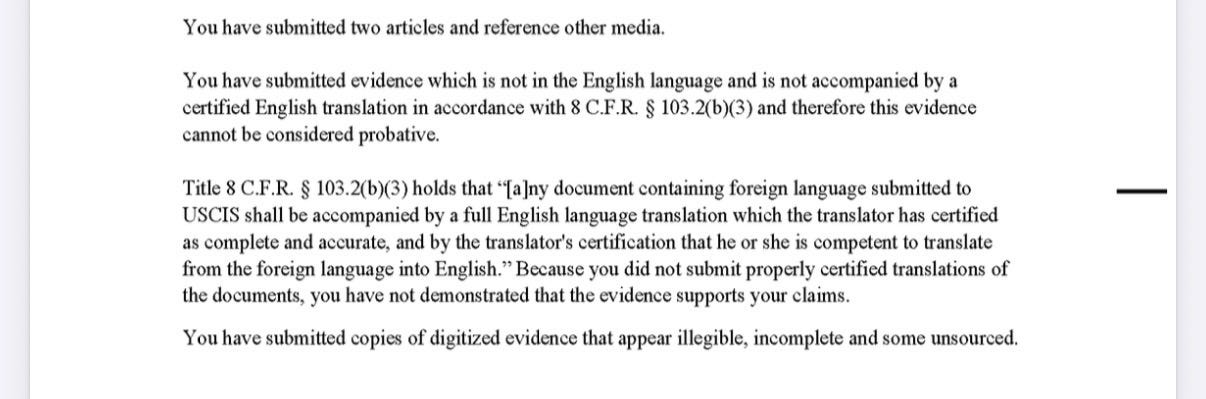
“You have submitted evidence which is not in the English language and is not accompanied by a certified English translation in accordance with 8 C.F.R. § 103.2(b)(3) and therefore this evidence cannot be considered probative.”
That single sentence means the officer has effectively set the document aside. Whatever it proved — a published article, an award, a media feature, a marriage certificate — it now proves nothing in the eyes of the adjudicator. This article explains what the regulation requires, why USCIS applies it so strictly, the related problems of illegible and unsourced evidence, and how petitioners can cure or prevent these deficiencies.
What 8 C.F.R. § 103.2(b)(3) Actually Requires
The regulation is short but absolute. It states that any document containing foreign language submitted to USCIS must be accompanied by a full English language translation that the translator has certified as complete and accurate, along with the translator’s certification that he or she is competent to translate from the foreign language into English.
Three distinct requirements are embedded in that text, and missing any one of them can sink the document:
1. The translation must be full. Partial translations, summaries, or translations of “the relevant portion” do not satisfy the regulation. If a newspaper article is submitted as evidence, the entire article must be translated — headline, byline, publication date, captions, and body text. USCIS officers regularly reject “extract” translations because they cannot verify that the untranslated portions don’t contradict or contextualize the translated ones.
2. The translator must certify completeness and accuracy. This is a written statement, signed by the translator, affirming that the translation is complete and accurate. A translation without this attestation — even a perfectly accurate one — technically fails the regulation.
3. The translator must certify their own competence. The certification must also state that the translator is competent to translate from the specific foreign language into English. Notably, the regulation does not require the translator to be “certified” by any professional body, sworn, or accredited. It does not require notarization. A bilingual friend or family member can, in theory, provide a compliant certification — though as discussed below, that carries practical risks.
A compliant certificate of translation typically looks something like this:
I, [Name], certify that I am competent to translate from [Language] into English, and that the attached translation is a complete and accurate translation of the original document titled [Document Name].
Signature, printed name, date, and contact information.
Why “Cannot Be Considered Probative” Is Such Damaging Language
“Probative” means tending to prove something. When USCIS declares evidence non-probative for lack of a certified translation, the officer is not saying the document is fraudulent or that its contents are false. The officer is saying the document carries zero evidentiary weight — it is as if it was never submitted.
This matters enormously in petitions that turn on meeting a specific number of regulatory criteria. In an EB-1A extraordinary ability petition, for example, the petitioner must satisfy at least three of ten criteria (or show a one-time major achievement). Published material about the beneficiary in professional or major media is one of those criteria. If the submitted articles are in a foreign language without compliant translations, the entire criterion can collapse — not because the coverage didn’t exist, but because USCIS cannot legally consider it.
The excerpt at the top of this article illustrates exactly this scenario: the petitioner “submitted two articles and reference other media,” but because certified translations were missing, the officer concluded the petitioner “have not demonstrated that the evidence supports your claims.” The burden of proof in immigration proceedings always rests on the petitioner, and untranslated evidence simply cannot carry that burden.
The Companion Problems: Illegible, Incomplete, and Unsourced Evidence
The same notice raises a second, closely related deficiency: “copies of digitized evidence that appear illegible, incomplete and some unsourced.” Each of these words points to a distinct failure:
Illegible. Low-resolution scans, faded photocopies, screenshots compressed beyond readability, or photographs of documents taken at an angle. If the officer cannot read it, the officer cannot weigh it. This is especially common with older newspaper clippings and web archive captures.
Incomplete. Cropped articles missing the headline or publication information, screenshots showing only part of a page, or documents missing pages. An article without a visible masthead or date cannot establish that it appeared in “professional or major trade publications or other major media,” which is the actual regulatory standard for the published-material criterion.
Unsourced. Perhaps the most underestimated problem. A block of text pasted into a Word document, or a screenshot with no URL, publication name, date, or author, has no provenance. USCIS has no way to verify where it came from. Evidence of media coverage should include the publication name, date, author (if available), and — for online sources — the URL, ideally alongside circulation or readership data establishing the outlet’s significance.
How to Cure These Deficiencies in an RFE Response
If you have received an RFE or Notice of Intent to Deny citing § 103.2(b)(3), the deficiencies are usually curable, and the response should be treated as an opportunity to rebuild the record properly:
Re-submit every foreign-language document with a fully compliant package. Each item should include (1) a clean, legible copy of the original, (2) a full English translation formatted to mirror the original, and (3) a signed translator’s certification covering both accuracy and competence. Do this even for documents you believe were previously translated — assume the record is being rebuilt from scratch.
Use a professional translation service where stakes are high. Although the regulation permits any competent translator, professional services provide standardized certifications, letterhead, and credibility. Avoid having the petitioner or beneficiary translate their own documents; self-translation invites credibility questions even if it is not strictly prohibited.
Replace illegible copies with better ones. Obtain fresh scans at 300 DPI or higher. For old print media, contact the publication’s archive. For online articles, submit full-page captures showing the URL, publication banner, and date — and consider printing to PDF rather than screenshotting.
Source everything. Attach a cover index identifying each exhibit: what it is, where it came from, when it was published, and which regulatory criterion it supports. For media evidence, add documentation of the outlet’s reach — circulation figures, web traffic data, or media kit information — since “major media” status must itself be proven.
Explain the fix in the response brief. Don’t just drop new documents into the envelope. A short cover explanation — “Exhibit 4 replaces the previously submitted article, now accompanied by a full certified English translation pursuant to 8 C.F.R. § 103.2(b)(3)” — helps the officer connect the cure to the deficiency.
Prevention: Building the Record Right the First Time
The best RFE response is the one you never have to write. Before filing any petition containing foreign-language evidence:
• Audit every exhibit page-by-page for foreign text — including seals, stamps, letterheads, and handwritten notations, which are frequently overlooked but still trigger the translation requirement.
• Translate everything in full, and staple or sequence each translation directly behind its original with the certification on top or attached.
• Print quality-check the entire package. If a page is hard to read on paper, it will be worse after USCIS digitizes it.
• Index and label all exhibits so that provenance is self-evident.
The Bigger Lesson
Regulations like § 103.2(b)(3) exist because USCIS adjudicators must be able to independently read and verify every piece of evidence in the record. The rule is mechanical and unforgiving, but it is also entirely within the petitioner’s control. Strong underlying facts are necessary but not sufficient; the record must be built so that an officer with no knowledge of the foreign language, the foreign publication, or the beneficiary’s field can look at each exhibit and understand exactly what it is, where it came from, and what it proves.
A petition lives or dies on its paper. Certified translations, legible copies, and clear sourcing are not formalities — they are the difference between evidence that counts and evidence that, in USCIS’s words, “cannot be considered probative.”
This article is for general informational purposes and is not legal advice. Petitioners facing an RFE or denial should consult a qualified immigration attorney about their specific case.