

When NIW Gets Misread: The Growing Gap Between Legal Standard and Petition Strategy
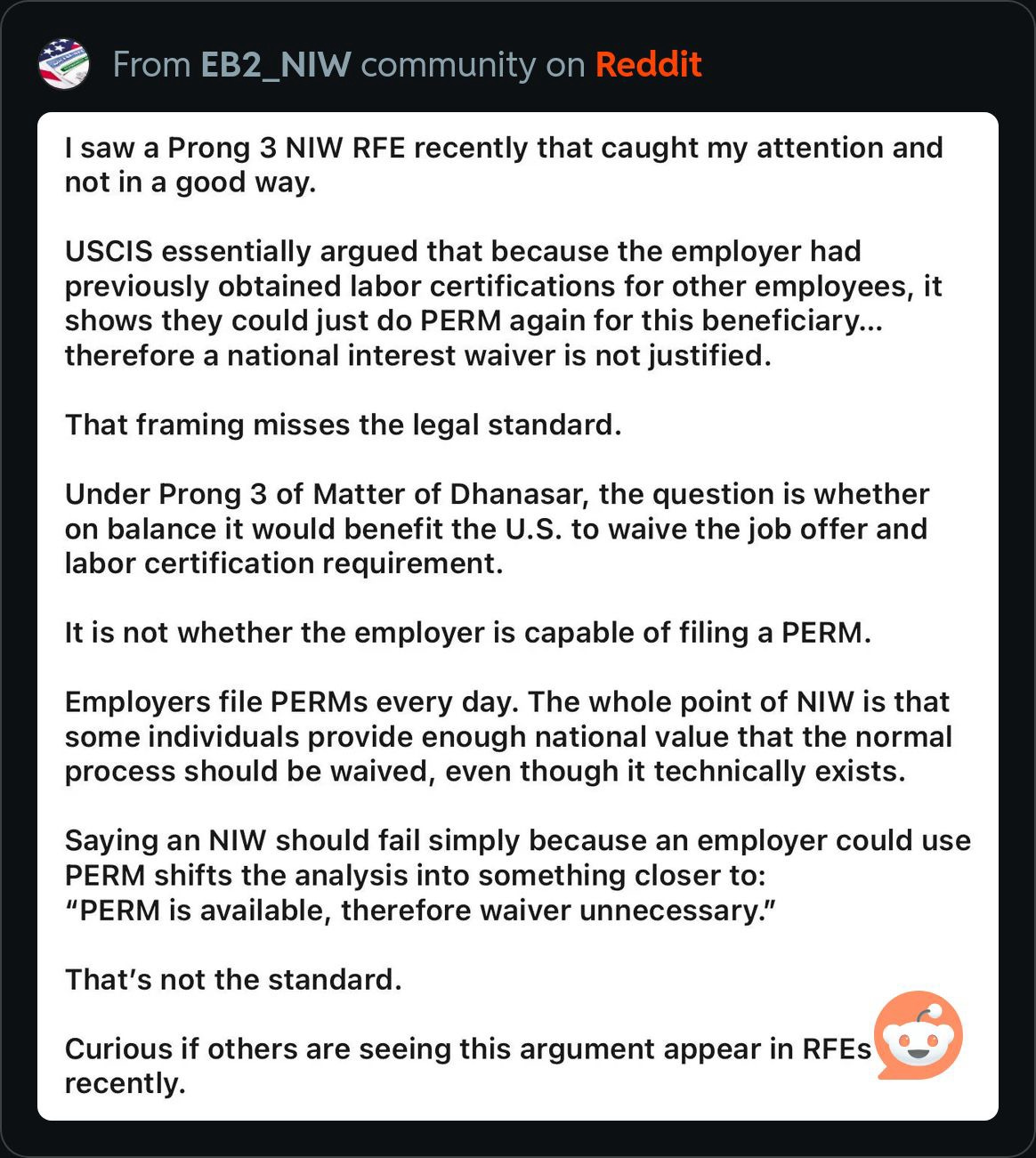
A recent discussion circulating in the EB2-NIW community highlights a subtle but serious shift in how certain Requests for Evidence are being framed. The case described was not unusual on the surface, yet the reasoning behind the RFE exposes a deeper issue that goes beyond a single petition.
The argument raised by USCIS in this instance was straightforward: since the employer had successfully filed PERM labor certifications for other employees, they could do the same again for this beneficiary. Therefore, a National Interest Waiver was not justified.
At first glance, that logic might seem sound. But it actually reveals a misunderstanding of the legal standard at the heart of NIW adjudication.
The Real Standard: What Prong 3 Actually Asks
Under Matter of Dhanasar, the third prong does not ask whether a job offer or labor certification is possible. It asks whether, on balance, it benefits the United States to waive those requirements.
That distinction matters.
PERM being available is nearly universal, employers file them every day. If the existence of PERM itself justified denying NIW, the category would almost never succeed. The waiver exists precisely because some individuals provide a degree of value that justifies bypassing what is otherwise a standard, employer-based process.
What’s emerging now is a shift in reasoning from, “Does this individual justify a waiver?” to “Is a waiver necessary if PERM exists?”
That subtle pivot changes the entire framework of evaluation.
Where Petitions Break Down
This kind of reasoning doesn’t happen randomly. It often surfaces when NIW petitions fail to control the narrative around Prong 3.
Many still follow a predictable, reactive pattern:
Present achievements
Describe importance
Assume the benefit is self-evident
The problem is that Prong 3 isn’t about achievements alone, it’s about comparative justification.
If a petition doesn’t explicitly show why the normal PERM route is insufficient, what would be lost by forcing that route, and how the applicant’s work extends beyond employer-specific interests, then it leaves open space for exactly this kind of misinterpretation.
And once that interpretive space exists, an officer’s analysis can slide away from the intended legal question entirely.
The Structural Problem: Lack of Explicit Alignment
This is not just an adjudication issue, it’s structural.
Candidates tend to think in terms of publications, roles, and achievements.
Attorneys think in terms of criteria, thresholds, and case law.
But Prong 3 needs something else: a structured argument balancing national benefit versus procedural requirement.
Without systems and templates that make that alignment clear early on, even robust profiles are vulnerable.
Why This Matters More Now
Patterns like these are not isolated outliers, they are signals.
When similar reasoning starts showing up in multiple RFEs, it points to:
A tightening interpretation environment
Greater emphasis on narrative precision
Less tolerance for implied or indirect arguments
In this environment, merit alone no longer secures approval.
Clarity of positioning becomes just as critical as the achievements themselves.
Reframing NIW: From Eligibility to Justification
The deeper lesson is simple.
NIW is not about proving that you’re qualified, it’s about proving why the system should make an exception for you.
That requires:
Structured articulation of impact
Clear, tangible linkage to national interest
A reasoned justification for bypassing PERM
Not as a supplementary argument, but as the foundation of the case.
The Takeaway
This RFE example isn’t just about faulty reasoning. It highlights a broader and growing disconnect between the legal standard and how petitions are assembled.
The real risk isn’t lack of merit, it’s lack of alignment.
And when that alignment fails, strong applicants can find their cases reframed in ways that subtly shift the burden back onto them.
The decisive question, then, is no longer “Do you qualify?”
It is “Have you proven why the normal process should not apply to you?”
That, increasingly, is where National Interest Waiver petitions are won—or lost.