

When a Strong EB-1A Profile Still Gets Denied: The Evidence Gap Nobody Talks About
I happened to read a Reddit post today from an EB-1A aspirant who received a denial after responding to an RFE.
What stood out was not that the profile was weak.
In fact, the profile looked objectively strong.
The applicant had a PhD in Electrical Engineering, more than 700 citations, 35 scholarly articles, 300+ journal reviews, 100+ conference reviews, associate editor roles in major IEEE journals, a patent, a book chapter, and a Best PhD Thesis Prize from IEEE.
On paper, many people would assume this is a strong EB-1A profile.
But USCIS still denied the case.
That is exactly why EB-1A evaluation is not just about collecting achievements. It is about proving the right kind of impact in the right way.
What Was the Denial Really About?
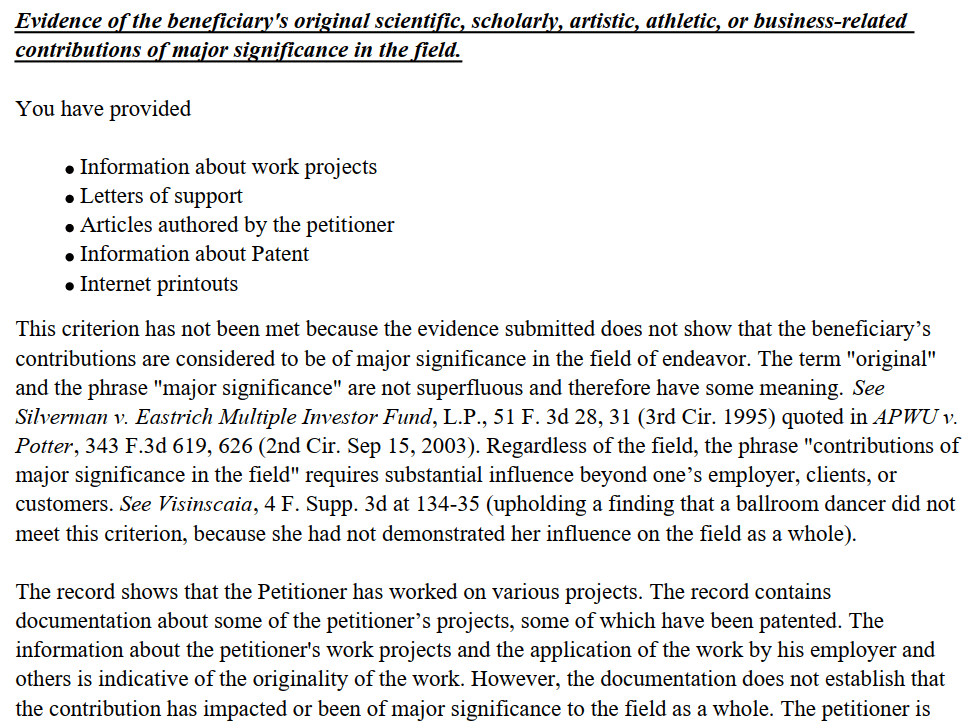
The denial focused on the “original contributions of major significance” criterion.
The applicant had submitted:
Letters of support
Information about work projects
Articles authored by the petitioner
Patent-related information
Internet printouts
Citation data
Evidence that some publications were among the top 5% most cited in the field
Still, USCIS found that the evidence did not establish that the applicant’s contributions were of major significance to the field as a whole.
That phrase is very important:
to the field as a whole.
USCIS was not saying the work was not original.
USCIS was not saying the person was not accomplished.
USCIS was not saying the research was not respected.
The issue was that the evidence did not sufficiently prove major significance beyond the applicant’s employer, collaborators, customers, or immediate research circle.
The Key USCIS Problem
The denial language made the core issue clear.
USCIS expects “major significance” to mean substantial influence beyond one’s employer, clients, or customers.
That is where many strong applicants get stuck.
They prove that their work exists.
They prove that their work is original.
They prove that others cite it.
They prove that respected people support them.
But they may still fail to prove that the work changed the field, influenced industry practice, became a benchmark, shaped standards, enabled future products, or was adopted broadly.
That is a higher evidentiary bar.
Why Letters Alone May Not Be Enough
The applicant submitted letters from well-known researchers who cited the work, used it as a benchmark, built upon it, and referred to it as a standard for certain applications.
That sounds strong.
But USCIS often discounts letters if they are not supported by independent, objective evidence.
A strong letter says:
“This person’s work is important.”
A stronger record shows:
Others adopted the work.
The work changed methods in the field.
The work became a benchmark.
The work influenced commercial products.
The work shaped technical standards.
The work was independently cited, implemented, replicated, or relied upon.
Letters help, but they are usually not enough by themselves. They need to be tied to external proof.
Why Citations Alone May Not Be Enough
The applicant had more than 700 Google Scholar citations and Scopus data showing some papers were among the top 5% most cited in the research area.
That is meaningful.
But citation counts alone may not automatically prove major significance.
USCIS may ask:
What did the citations actually say?
Did the citing papers merely mention the work?
Did they rely on it?
Did they reproduce it?
Did they use it as a benchmark?
Did the work influence a method, standard, product, or direction in the field?
This is why raw citation numbers need interpretation.
A citation table is good.
A citation impact map is better.
What This Applicant Was Really Facing
This was not a “weak profile” problem.
This was a “translation problem.”
The applicant had academic strength, research output, peer review experience, editorial credibility, and citations.
But EB-1A requires the evidence to be framed toward extraordinary ability and sustained acclaim, not simply academic productivity.
The missing bridge may have been:
From citations to field influence
From patent submission to commercial or technical importance
From scholarly respect to practical adoption
From researcher recognition to major significance
From strong credentials to final merits
That bridge is where many petitions succeed or fail.
Appeal or Refile?
Generally speaking, an AAO appeal is usually harder if the denial is based on how USCIS weighed the evidence rather than a clear legal or factual error.
If the record already submitted does not clearly prove major significance, an appeal may not fix the issue unless the applicant can show USCIS ignored or misapplied evidence already in the record.
A refile may be stronger if the applicant can restructure the case, add clearer evidence, and build a stronger impact narrative.
For this type of profile, the refile should not simply submit more of the same evidence. It should reorganize the evidence around the question USCIS actually cares about:
How did this person’s work influence the field beyond their own institution, employer, collaborators, or immediate research group?
Should the Applicant Consider EB-2 NIW?
Possibly, yes.
Based on the profile, EB-2 NIW may be a strong alternative, especially because the applicant is from Europe and may not face the same backlog pressure as India or China-born applicants.
EB-2 NIW focuses more on proposed endeavor, substantial merit, national importance, ability to advance the endeavor, and whether waiving the job offer requirement benefits the United States.
This profile may fit EB-2 NIW very well, especially with work in electric transportation, renewable energy, patents, publications, and a future tenure-track role.
But EB-2 NIW is not necessarily a replacement for EB-1A. It can be a parallel or backup strategy depending on timing, visa bulletin category, and the applicant’s goals.
What Meritocrat Would See Here
From a Meritocrat perspective, this profile would not be marked as weak.
It would likely be flagged as:
Strong profile, but evidence-risk exists under original contributions and final merits.
The applicant clearly has academic and technical achievements. But the key issue is whether the submitted evidence proves major significance at the field level.
Meritocrat’s evaluation would focus on questions such as:
Does the evidence show adoption beyond citations?
Do the citations prove reliance or just mention?
Does the patent show commercial or technical implementation?
Did the work influence standards, products, policy, industry methods, or research direction?
Are the recommendation letters supported by independent evidence?
Is there evidence from people who are not close collaborators?
Does the record prove individual contribution, not just team or lab output?
Does the final merits story show sustained acclaim?
The Bigger Lesson
This Reddit post shows one of the most important realities in EB-1A:
A strong academic profile does not automatically become a strong EB-1A petition.
The profile may be impressive.
The applicant may be highly qualified.
The work may be original.
The publications may be respected.
The reviewers may be credible.
But USCIS still wants proof that the applicant’s work rose to the level of major significance in the field.
That is a different question.
Meritocrat’s Stand
Meritocrat’s stand is simple:
Applicants should not only ask, “Do I have enough achievements?”
They should ask:
Can each achievement survive USCIS-style evidence review?
That means evaluating not just the quantity of evidence, but the quality, relevance, independence, and field-level impact of that evidence.
For EB-1A, EB-2 NIW, and O-1A, applicants need more than document collection.
They need evidence reasoning.
They need to know:
What evidence is strong
What evidence is weak
What evidence is being overestimated
What claims need independent proof
What criteria are likely to survive review
What criteria may trigger RFE or denial
Whether to appeal, refile, or pursue another category
Final Takeaway
This denial is a reminder that EB-1A is not only about excellence.
It is about documented, field-level excellence.
The applicant had a strong profile. But USCIS did not appear convinced that the evidence proved original contributions of major significance to the field as a whole.
That is the gap Meritocrat is trying to help applicants and attorneys identify earlier:
before the RFE, before the denial, before the retainer is spent, and before strong applicants mistake strong achievements for strong evidence.