

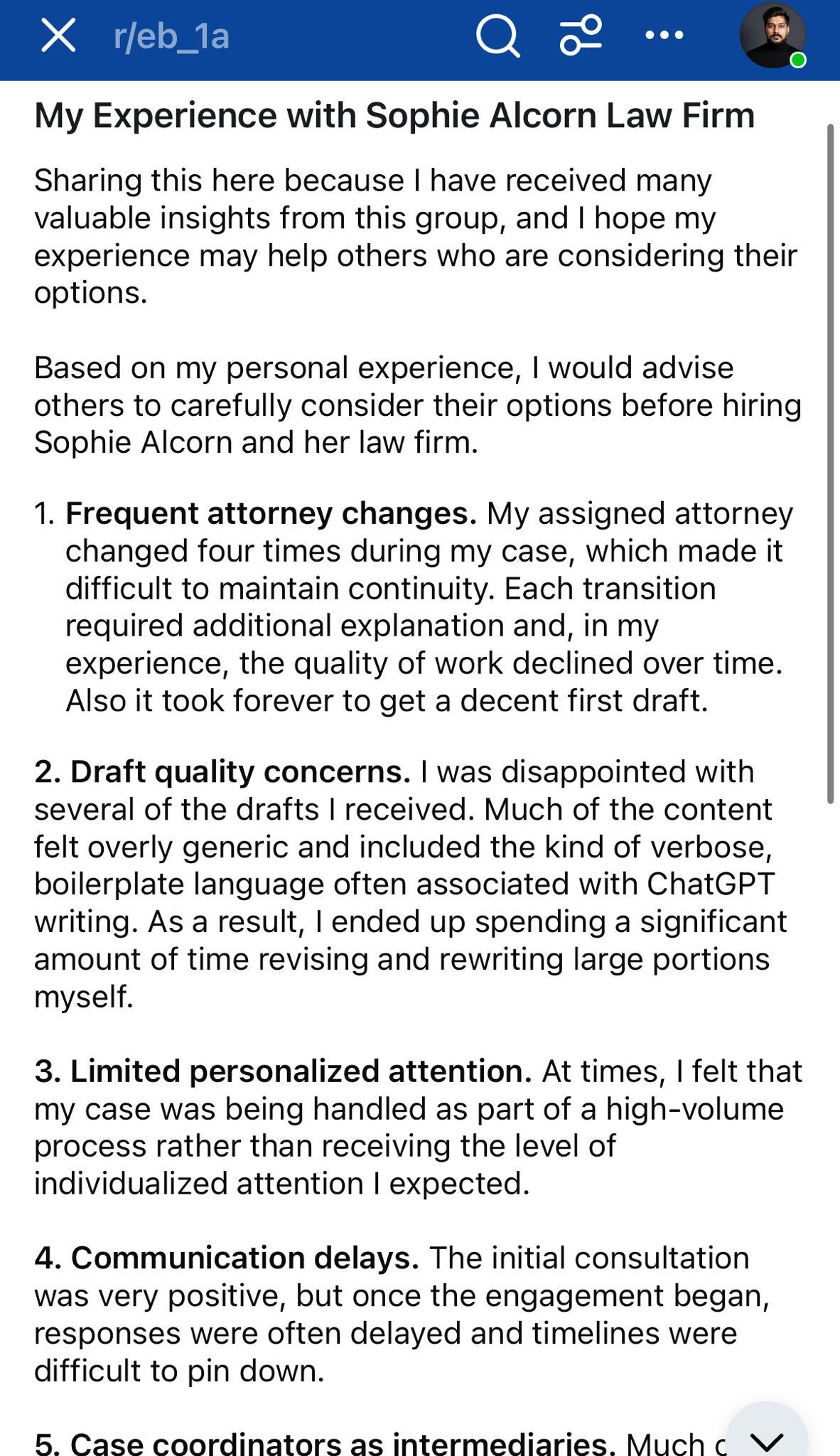
A recent Reddit post in the EB-1A community caught my attention.
The post described one applicant’s personal experience with Sophie Alcorn Law Firm. The applicant raised concerns around attorney changes, draft quality, limited personalized attention, communication delays, and case coordinators acting as intermediaries. This is only one person’s experience, and it should not be treated as a complete picture of any law firm. But the concerns raised are familiar to many people preparing high-stakes immigration cases.
Original Reddit post:
https://www.reddit.com/r/eb_1a/s/lTOYwFYaWK
The point is not to criticize one law firm.
The point is to look at the workflow behind the experience.
Because in EB-1A, EB-2 NIW, and O-1A cases, a lot of friction begins before legal drafting ever starts.
The real issue: applicants bring evidence, but attorneys need structured case intelligence
Most applicants do not come to an attorney with a clean legal story.
They come with scattered evidence.
A resume.
A LinkedIn profile.
Award certificates.
Recommendation letters.
Salary screenshots.
Patent links.
Media mentions.
Conference talks.
Publications.
Internal company impact.
Screenshots from projects.
A few documents that feel important but are hard to explain.
For the applicant, these are achievements. For the attorney, they are raw materials.
The attorney still has to understand what matters, what does not, what maps to a legal criterion, what is weak, what needs support, what can become a claim, and what may create risk.
That translation layer is where a lot of time is lost.
And when that layer is missing, the same problems keep showing up.
What the Reddit post reveals about the workflow gap
The Reddit post mentioned five pain points. Each one points to a deeper operational issue that can happen in high-volume immigration workflows.
1. Frequent attorney changes create continuity problems
When a case moves from one attorney to another, the next person needs context.
Not just documents. They need to know why each document matters.
They need to understand the applicant’s professional arc, strongest claims, weakest criteria, previous decisions, unanswered questions, and evidence gaps.
Without a structured workspace, every transition creates friction.
The applicant may need to explain the same story again. The attorney may need to rebuild context. The coordinator may become the translator between the applicant and the legal team.
That is not only frustrating. It can weaken the quality of preparation.
2. Draft quality often suffers when the facts are not specific enough
Generic drafting is rarely just a writing problem.
It is often a fact-structure problem.
If the source material is vague, scattered, or poorly mapped, the draft can become broad, repetitive, and generic. It may describe the applicant as “highly accomplished” without showing enough concrete proof of originality, impact, leadership, recognition, or sustained acclaim.
For strong evidence-based immigration cases, the draft needs to come from specific facts.
What did the applicant build?
Who used it?
What changed because of it?
How was the impact measured?
Who recognized the work?
Why does it matter beyond routine job performance?
Without that structure, even a skilled attorney can spend too much time extracting the story.
3. Personalized attention becomes harder when every case starts as a document dump
Many applicants expect highly personalized strategy.
But if every case begins with hundreds of pages of unmapped material, the legal team first has to do administrative reconstruction before they can do strategic analysis.
That is where personalization gets squeezed.
The attorney may want to focus on strategy, but the workflow pulls them into sorting, reading, clarifying, and organizing.
This is especially important for EB-1A, EB-2 NIW, and O-1A because these cases depend heavily on individual merit, field context, and evidence quality. They are not simple form-filling exercises.
4. Communication delays often reflect unclear readiness
Applicants usually ask reasonable questions.
Where are we in the process?
What is missing?
Which criteria are strong?
Which evidence is weak?
When can drafting start?
Why is this document not enough?
But if the case does not have a visible readiness map, every answer requires manual review.
The applicant waits.
The coordinator follows up.
The attorney checks the file.
The applicant sends more documents.
The legal team reviews again.
This loop creates delays, even when everyone is trying to do the right thing.
5. Coordinators become intermediaries when information is not attorney-ready
Case coordinators play an important role in law firm operations.
But in complex immigration cases, there is a difference between collecting documents and preparing attorney-ready context.
A coordinator can collect files, send reminders, and manage communication.
But the attorney still needs structured legal context.
That means claims, evidence, criteria mapping, gaps, contradictions, supporting documents, and narrative logic.
Without that structure, coordinators become the bridge between raw applicant information and attorney judgment. That bridge can become slow and frustrating for both sides.
The larger lesson from the Reddit post
The Reddit post should not be reduced to one firm or one complaint.
It reflects a broader issue in evidence-based immigration preparation.
Applicants feel frustrated when they do not understand the process.
Attorneys feel burdened when evidence arrives unstructured.
Coordinators become overloaded when they are asked to translate between both sides.
Drafts become weaker when the underlying facts are unclear.
Communication slows when readiness is not visible.
These are not just service problems.
They are infrastructure problems.
And infrastructure problems need workflow solutions.
High-stakes immigration is not only about forms, documents, or drafting.
It is about turning a person’s professional life into a credible, evidence-backed legal story.
That process needs structure.
It needs clarity.
It needs attorney judgment.
And it needs better preparation before the case reaches the attorney’s desk.
That is why Meritocrat exists.
To help applicants prepare with structure.
To help attorneys review with context.
To help law firms receive cleaner, evidence-backed clients.
And to make the space between applicant effort and legal strategy less chaotic.
Applicants prepare.
Attorneys decide.
Meritocrat helps structure the bridge.