

The U.S. Department of State expanded online presence reviews for nonimmigrant visas on March 25, 2026, effective March 30, adding categories like K-1 fiancés and T/U victims. This builds on prior H-1B and student visa scrutiny, requiring public social media profiles amid rising national security focus. A recent USCIS precedent links these via H-1B integrity enforcement.
Policy Background and Timeline
Social media vetting began for F, M, J students/exchange visitors in June 2025, then H-1B/H-4 in December 2025. The 2026 expansion—third and largest—covers 14 more: A-3, C-3 (domestic workers), G-5, H-3/H-4 (H-3 dependents), K-1/2/3, Q, R-1/2, S, T, U. Applicants must set all profiles (e.g., Facebook, Instagram) to “public” or “open” for five years’ handles on DS-160 forms.
Every adjudication is a “national security decision,” using all data to check inadmissibility or threats. Delays may rise; content must align with visa intent (e.g., no contradicting travel purpose).
This table shows progression from professionals/students to families and vulnerable groups.
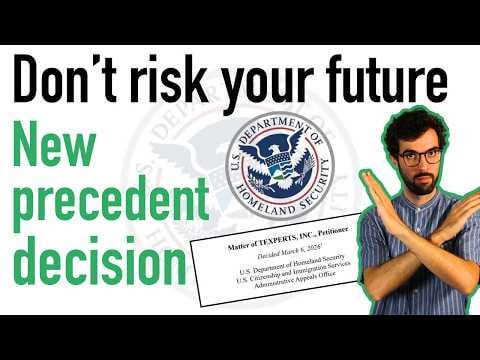
AAO precedent Matter of TEXPERTS, INC. (29 IN Dec. 491, AAO 2026), addressing H-1B fraud in cap registrations. While the decision focuses on multiple registrations and misrepresentations under 8 C.F.R. § 214.2(h)(8)(iii)(A)(2), it connects to the announcement via shared H-1B emphasis on integrity. The AAO stresses materiality of misrepresentations in petitions, mirroring State Department’s vetting for credibility in H-1B processes
Connection to USCIS H-1B Fraud Precedent
Matter of TEXPERTS, INC. (29 I&N Dec. 491, AAO 2026) sets precedent: USCIS can find fraud/misrepresentation post-H-1B petition withdrawal if collusion (e.g., shared IP, ownership) skirts cap lotteries. Director must detail elements like willfulness/materiality, even after withdrawal (8 C.F.R. § 103.2(b)(15)).
This ties to State vetting: H-1B social media flags inconsistencies, amplifying USCIS scrutiny on attestations. Fraud impacts future benefits/admissibility (INA § 212(a)(6)(C)(i)).
Practical Impacts for Applicants
Review/clean profiles: Delete risky posts; ensure consistency with petitions (e.g., job claims). Tech founders filing H-1B roles should audit beneficiaries’ online history. Processing delays expected; provide purpose details from travel.state.gov.
For EB-1A/NIW ties, public profiles support “extraordinary ability” narratives. Victims (T/U) face irony in vulnerability exposure.
Compliance Steps
List all platforms/handles (last 5 years) on DS-160.
Set privacy to public before interview.
Align content with visa evidence (e.g., H-1B job offers).
Consult attorneys for audits/withdrawals.
Violations risk denials, bars, or cap restoration blocks (INA § 214(g)(3)).
Broader Implications
Under President Trump, this reflects vigilant screening post-reelection. Ties to H-1B reforms combat fraud, aiding legitimate tech immigration ventures. Expect DS-160 updates and more AAO guidance.
Thank you to u/OscarsGreenCard and this post https://www.reddit.com/r/EB2NIW_EB1A/comments/1rqcicx/new_precedent_decision_uscis_can_now_make_fraud/