

Roast My EB-1A Profile: Tech Lead at Fortune 500 Clients, but All My “Wow” Work Is Proprietary
Strong Work Is Not Always Strong Evidence: What an EB-1A Aspirant’s Reddit Post Reveals
I happened to read a Reddit post today from an EB-1A aspirant, and it raised a very important issue that many high-skilled professionals face.
The applicant was not asking a basic question like, “Do I qualify?”
The deeper question was:
What happens when your strongest work is real, high-impact, and technically complex, but most of it is proprietary, confidential, or not publicly tied to your name?
That is a serious EB-1A issue.
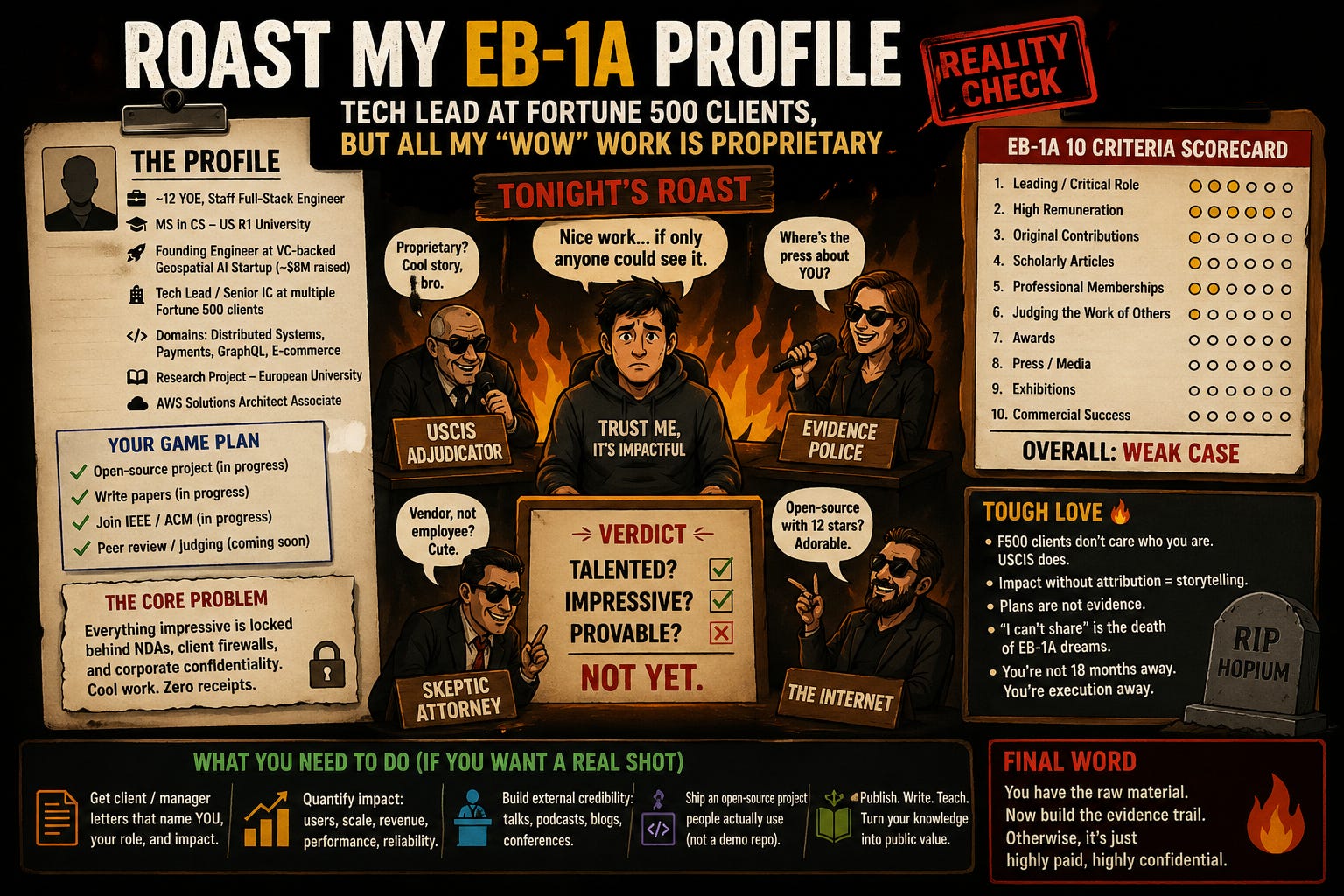
The Applicant’s Situation
The applicant described a strong technology background.
They had around 12 years of experience, worked as a Staff full-stack engineer, studied Computer Science at a U.S. R1 university, and had founding-engineer experience at a VC-backed geospatial AI startup.
They also worked on complex systems involving distributed transactions, payment orchestration, federated GraphQL gateways, e-commerce infrastructure, and enterprise-scale platforms.
On top of that, they had worked with multiple Fortune 500 clients across major industries.
So the profile was not weak.
The problem was that the strongest work was difficult to prove.
The Real Issue
The applicant’s concern was simple but very important:
Most of their “wow” work happened behind enterprise walls.
They could not share internal architecture diagrams.
They could not disclose confidential system metrics.
They could not publish client-specific implementation details.
They could not easily show how much business impact their work created.
They could not rely on press coverage because the product was covered, but their name was not mentioned.
This creates a major evidence gap.
For EB-1A, the issue is not only whether someone did great work. The issue is whether that work can be documented, validated, and connected directly to the applicant.
The Applicant’s Key Questions
The applicant was really asking five practical questions.
1. Is 18 to 24 months enough to become fileable?
The honest answer is: maybe, but only with focused execution.
If the applicant already has strong remuneration and a possible critical-role argument, 18 to 24 months may be enough to build missing external validation.
But that timeline only works if the applicant actively builds evidence, such as publications, open-source adoption, judging roles, speaking opportunities, and strong recommendation letters.
If the next 18 months are only spent doing more internal company work, the profile may not change much.
2. Does vendor-at-Fortune-500 work count?
It can count, but it needs careful framing.
Being a vendor or consultant does not automatically make the work weak. Many consultants perform mission-critical work for major companies.
But the petition must prove that the applicant was not just part of a vendor team. It must show that the applicant personally played a leading or critical role in a distinguished organization or distinguished project.
That means client letters, manager letters, project impact statements, technical ownership, and measurable business value become very important.
3. Is product press useful if the applicant is not named?
It is useful as background, but weak as direct evidence.
If the press only talks about the product or company, and does not name the applicant, it does not strongly prove the applicant’s individual recognition.
To make it stronger, the applicant would need supporting evidence showing that they were one of the key contributors behind the product that received coverage.
That could come from company letters, founder letters, public case studies, conference talks, podcasts, or follow-up articles that name the applicant.
4. What makes open source meaningful for EB-1A?
Open source becomes meaningful when it shows adoption and impact.
A GitHub repository alone is not enough. Stars alone may not be enough either.
Stronger evidence includes weekly downloads, dependent packages, external contributors, named corporate users, technical citations, documentation from users, conference mentions, and letters from engineers or companies relying on the tool.
The key question is not, “Did you create it?”
The better question is:
Did the field use it?
5. Can someone succeed in EB-1A without a PhD?
Yes, but the evidence must be strong.
A PhD is not required for EB-1A. But without a PhD, the applicant usually needs other strong evidence of distinction.
That may include major open-source adoption, industry-recognized contributions, high-impact publications, judging, critical roles, media recognition, high remuneration, or influential technical leadership.
The burden shifts from academic credentials to documented industry impact.
The Bigger Lesson
This post shows a common misunderstanding.
Many applicants think:
“I did important work, so my case should be strong.”
But immigration evidence works differently.
The stronger question is:
“Can I prove my important work with independent, credible, well-organized evidence?”
That is where many strong professionals struggle.
They may have real impact, but the evidence is hidden, scattered, confidential, or not connected clearly to them.
Strong Work Is Not Always Strong Evidence
This is the central lesson.
A person may build enterprise systems used by millions.
A person may support Fortune 500 platforms.
A person may solve hard engineering problems.
A person may be respected internally by senior teams.
But if there is no external validation, no clear documentation, no measurable impact, and no direct connection between the applicant and the work, the petition becomes harder.
For EB-1A, EB-2 NIW, and O-1A, internal excellence must be translated into immigration-ready evidence.
Meritocrat’s Stand
Meritocrat’s stand is simple:
Applicants should not guess their immigration strength based only on career confidence. They need structured evidence clarity before they file.
A strong career does not automatically mean a strong petition.
A weak-looking profile may have hidden strengths.
A strong-looking profile may have serious evidence gaps.
That is why structured evaluation matters.
Meritocrat is being built to help applicants and attorneys identify:
What evidence is already strong
What evidence is weak
What criteria may be supportable
What claims are risky
What needs third-party validation
What work should be built before filing
What looks impressive internally but may not work externally
What should be reviewed by an attorney before strategy is finalized
Why This Matters
Most applicants do not need hype.
They need clarity.
They need to know whether they are ready to file now, whether they need 12 months of evidence building, or whether they are still several years away.
That clarity can save attorney time, applicant money, and emotional energy.
Final Takeaway
The Reddit post was a strong reminder that many high-skilled professionals are not struggling because they lack talent.
They are struggling because their evidence is not ready.
EB-1A is not just about being impressive. It is about proving that distinction in a way an adjudicator can understand, trust, and connect directly to the applicant.
That is the gap Meritocrat wants to help close:
from strong work to strong evidence, from scattered achievements to structured evaluation, from self-assessment to attorney-ready clarity.