

Meritocrat as the Prefiling Intelligence Layer in Immigration Legal Tech

Immigration legal work is not only about filing forms or drafting petitions. For high-skill immigration categories such as EB-1A, EB-2 NIW, O-1, EB-1B, and similar merit-based pathways, the most difficult work often happens before filing. Applicants must understand whether their background is strong enough, attorneys must identify the right legal strategy, evidence must be organized carefully, and the final petition must connect every claim to credible proof.
This is where Meritocrat fits into the immigration legal tech ecosystem.
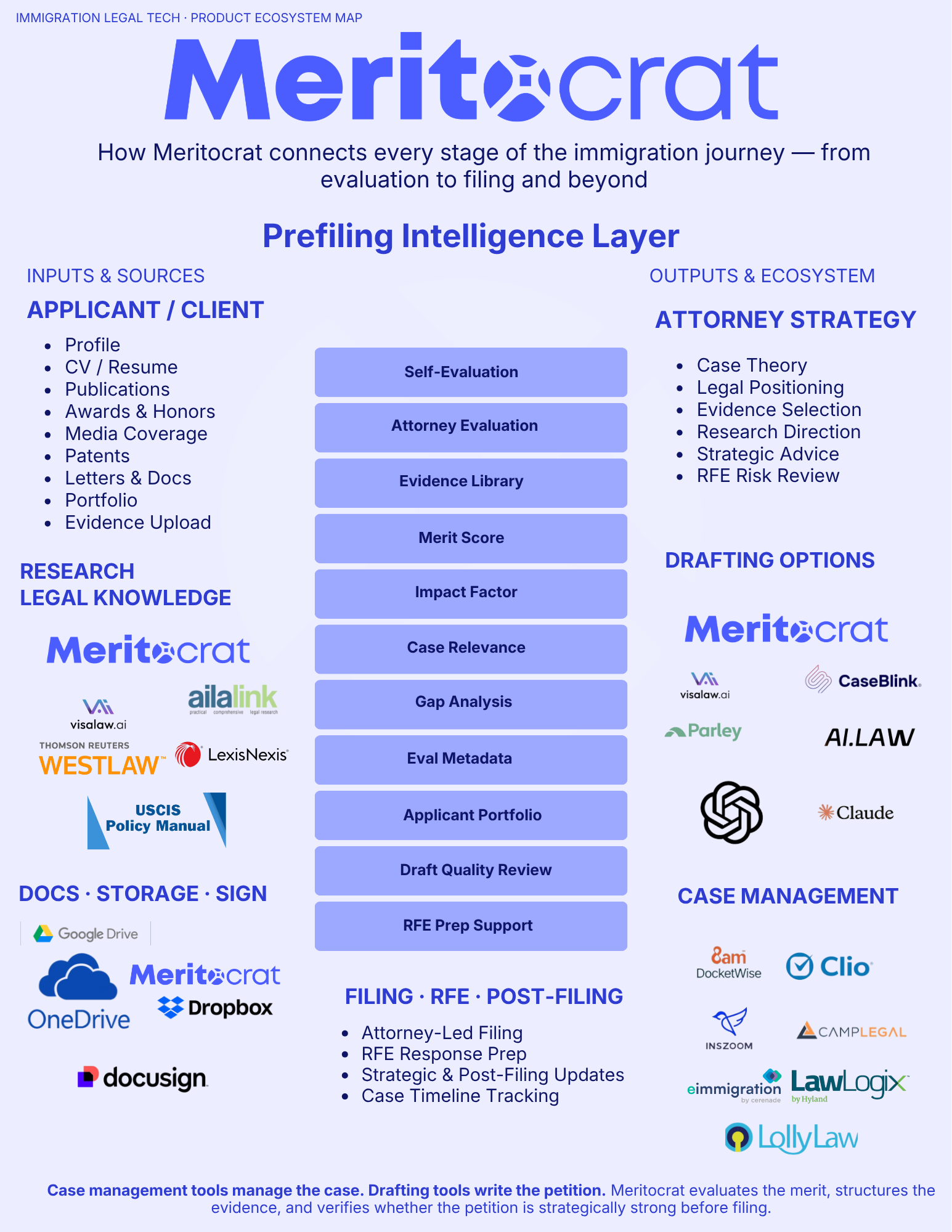
Meritocrat is designed as a prefiling intelligence layer that connects applicants, attorneys, evidence, research, drafting tools, case management systems, and post-filing strategy into one structured workflow. It does not replace attorneys, drafting tools, or case management platforms. Instead, it fills the critical gap between raw applicant information and attorney-ready petition strategy.
The problem in the current immigration workflow
Most immigration applicants begin with scattered information. Their achievements may exist across a resume, LinkedIn profile, publications, awards, media coverage, patents, recommendation letters, employment records, project summaries, and supporting documents. Some applicants do not know which achievements matter. Others may overvalue weak evidence or overlook stronger evidence.
Attorneys also face a major challenge. Before they can create a strong petition strategy, they must first understand the applicant’s background, verify the strength of the evidence, identify gaps, and decide which legal criteria are most appropriate. This takes time and often requires multiple rounds of intake, document review, clarification, and evidence restructuring.
Traditional legal tech tools usually focus on either case management, document storage, drafting, or filing workflows. These tools are useful, but they do not fully solve the pre-filing intelligence problem. A case management system can track deadlines. A drafting tool can help write a petition. A storage platform can hold documents. But none of these alone answers the deeper strategic question:
Is this applicant’s profile strong, well-supported, and ready for attorney-led filing?
That is the problem Meritocrat is built to solve.
Meritocrat’s role in the ecosystem
The immigration legal tech ecosystem includes several categories of tools.
Applicants bring the raw inputs: profile, CV, publications, awards, media coverage, patents, letters, documents, portfolio details, and evidence uploads.
Research and legal knowledge sources provide legal context. These may include USCIS policy materials, legal research platforms, and immigration-focused knowledge resources.
Document, storage, and signing tools help store and exchange information. Examples include Google Drive, OneDrive, Dropbox, DocuSign, and similar platforms.
Drafting tools help prepare petition language. These may include immigration drafting platforms, general AI tools, and attorney internal templates.
Case management tools help firms manage the case lifecycle. These platforms assist with workflows, client tracking, deadlines, forms, and operational management.
Meritocrat sits between these systems as the intelligence layer. Its role is to evaluate the applicant’s merit, structure the evidence, identify gaps, and help determine whether the case is strategically strong before the attorney proceeds with drafting and filing.
Applicant and client inputs
Every strong immigration case begins with applicant information. However, raw information by itself is not enough. A resume may show job titles, but not impact. A publication list may show authorship, but not citation value or field relevance. A media article may look impressive, but may not support the right legal criterion. A recommendation letter may be persuasive, but only if it connects to the right evidence and case theory.
Meritocrat helps convert applicant inputs into structured case intelligence. Key inputs include:
Profile information, CV or resume, publications, awards and honors, media coverage, patents, letters and supporting documents, portfolio details, and uploaded evidence.
Instead of leaving this information as scattered files, Meritocrat organizes it into a framework that can support legal analysis and attorney review.
The Meritocrat intelligence workflow
At the center of the ecosystem is Meritocrat’s pre-filing intelligence workflow. This includes several connected functions.
Self-Evaluation allows applicants to understand their profile before engaging deeply in the legal process. It helps them see whether their achievements may align with merit-based immigration categories.
Attorney Evaluation supports attorney-guided review. The attorney can bring legal judgment, strategy, and case-specific interpretation while Meritocrat structures the underlying information.
Evidence Library organizes documents and achievements in a way that is easier to review, compare, and use during petition preparation.
Merit Score provides a structured signal of profile strength. This can help applicants and attorneys understand whether the case appears promising, incomplete, or risky.
Impact Factor helps analyze the significance of achievements. In merit-based immigration, impact matters. It is not enough to list work performed. The applicant must show meaningful contribution, recognition, influence, or importance in the field.
Case Relevance helps determine whether a piece of evidence actually supports the immigration category or legal criterion being pursued.
Gap Analysis identifies missing evidence, weak areas, unsupported claims, or areas requiring stronger documentation.
Evaluation Metadata adds structure to the review process by connecting evidence, criteria, reasoning, and review context.
Applicant Portfolio creates a more organized version of the applicant’s background, making it easier for attorneys to understand the case.
Draft Quality Review checks whether the petition draft matches the evidence and whether claims are properly supported.
RFE Preparation Support helps applicants and attorneys prepare for potential issues before or after filing.
Together, these capabilities create a structured bridge between applicant preparation and attorney strategy.
Attorney strategy and legal judgment
Meritocrat is not designed to replace attorneys. Immigration law requires legal judgment, ethical responsibility, and professional interpretation. The attorney remains responsible for legal strategy, petition positioning, and filing decisions.
Meritocrat supports attorneys by making the preparation process more efficient and structured. Once applicant data and evidence are organized, attorneys can focus on higher-value work such as case theory, legal positioning, evidence selection, research direction, strategic advice, and RFE risk review.
This distinction is important. Meritocrat does not simply generate content. It helps create a better foundation for attorney decision-making.
A strong attorney strategy depends on understanding what evidence is available, what evidence is missing, what claims can be supported, and which legal path is strongest. Meritocrat helps surface these questions earlier in the process.
Drafting tools write the petition, but Meritocrat verifies the strategy
The ecosystem map shows several drafting options, including immigration-specific drafting tools and general AI tools. These tools can help write petition language, organize arguments, or speed up document creation.
However, drafting is only one part of the immigration workflow.
A beautifully written petition is not necessarily a strong petition. The quality of the petition depends on whether the claims are supported by evidence, whether the evidence maps to the right criteria, whether the strongest facts are emphasized, and whether weak or unsupported claims are avoided.
This is why Meritocrat plays a different role from drafting tools.
Drafting tools help write. Meritocrat helps evaluate whether the case logic is strong before and after drafting.
This includes questions such as:
Does the draft match the evidence?
Are the claims supported?
Are the criteria mapped correctly?
Is the strongest evidence being used?
Are important gaps still present?
Is the petition strategically positioned?
This quality review layer can help reduce avoidable weaknesses before filing.
Case management tools manage the case
Case management systems are essential for law firms. They help manage clients, deadlines, forms, tasks, workflows, communications, and filing operations. Tools such as Docketwise, Clio, INSZoom, CampLegal, eimmigration, LawLogix, LollyLaw, and others serve this operational function.
However, case management is different from case intelligence.
A case management platform may know that a petition is due next week. It may store the client’s documents. It may track intake completion. But it may not know whether the applicant’s evidence is strong, whether the case theory is persuasive, or whether the petition draft fully reflects the evidence.
Meritocrat complements these platforms by providing prefiling intelligence before the case reaches the final drafting and filing stage.
Filing, RFE, and post-filing support
The immigration journey does not end when a petition is filed. Attorneys and applicants may need to respond to RFEs, prepare additional evidence, update case strategy, track timelines, and strengthen the record after submission.
Meritocrat can support this stage by preserving the structured evaluation history, evidence library, merit analysis, and gap review. If an RFE arrives, the attorney and applicant do not need to start from scratch. They can revisit the evaluation metadata, identify what was already submitted, determine what was missing, and prepare a more focused response.
This creates value not only before filing, but also during post-filing strategy.
Why the prefiling layer matters
In immigration, weak preparation can create problems later. A case may fail not because the applicant lacks achievements, but because the evidence was not organized properly, the strongest facts were not emphasized, or the petition made claims that were not fully supported.
The prefiling stage is where many of these problems can be prevented.
Meritocrat’s value is in helping applicants and attorneys answer three important questions before filing:
What is the applicant’s true merit profile?
What evidence supports that profile?
Is the petition strategically strong enough to move forward?
By answering these questions earlier, Meritocrat can reduce confusion for applicants and improve efficiency for attorneys.
A practical example
An applicant may begin the process feeling confused. They may have a strong background but may not know how to present it. They reach out to an attorney, who gives legal direction and strategy. The applicant then organizes evidence, gathers documents, and prepares supporting information. The attorney uses that organized information to create the petition strategy and draft. The case is filed, and the applicant receives approval.
Meritocrat is designed to make this journey more structured.
Instead of relying on scattered emails, folders, and unclear evidence lists, the applicant can use Meritocrat to organize their background. The attorney can then review a structured portfolio rather than raw, disconnected information. The drafting stage becomes more efficient because the evidence and strategy are already clearer.
This improves the experience for both sides.
Applicants gain clarity. Attorneys gain efficiency. The petition gains stronger alignment between claims, evidence, and strategy.
Meritocrat’s position in the future of immigration legal tech
The future of immigration legal tech will not be defined by one tool replacing every other tool. Instead, the strongest systems will work together. Applicants will need preparation tools. Attorneys will need strategy and review workflows. Firms will need case management systems. Drafting tools will continue to improve. Research platforms will remain important.
Meritocrat’s role is to connect these pieces through intelligence.
It sits between applicant preparation and attorney execution. It helps transform raw information into structured immigration case insight. It supports evidence organization, merit evaluation, draft quality review, gap analysis, and RFE preparation.
In simple terms:
Case management tools manage the case. Drafting tools write the petition. Meritocrat evaluates the merit, structures the evidence, and verifies whether the petition is strategically strong before filing.
That is the core message of the Meritocrat ecosystem map.
Conclusion
Meritocrat is not just another immigration tool. It is a pre-filing intelligence layer for merit-based immigration cases. It helps applicants understand their profile, helps attorneys receive better-organized evidence, and helps ensure that petition strategy is based on structured, relevant, and supportable information.
For applicants, Meritocrat provides clarity before they invest time and money into a complex process.
For attorneys, Meritocrat improves efficiency by reducing intake chaos and organizing evidence before drafting begins.
For the broader immigration legal tech ecosystem, Meritocrat connects the missing layer between applicant data, attorney strategy, drafting, case management, filing, and RFE response.
The result is a more structured, intelligent, and attorney-aligned immigration workflow.