

ICE’s OPT Crackdown Is Just the Beginning. EB‑1 Is Next.
https://www.politico.com/news/2026/05/12/ice-optional-practical-training-fraud-00916797

Immigration and Customs Enforcement says it has uncovered more than 10,000 potential fraud cases in the Optional Practical Training (OPT) program, the work authorization many international students rely on after graduation. Acting ICE Director Todd Lyons has gone further, calling OPT “a magnet for fraud” and signaling that this is not a one‑off headline but the start of a broader campaign.
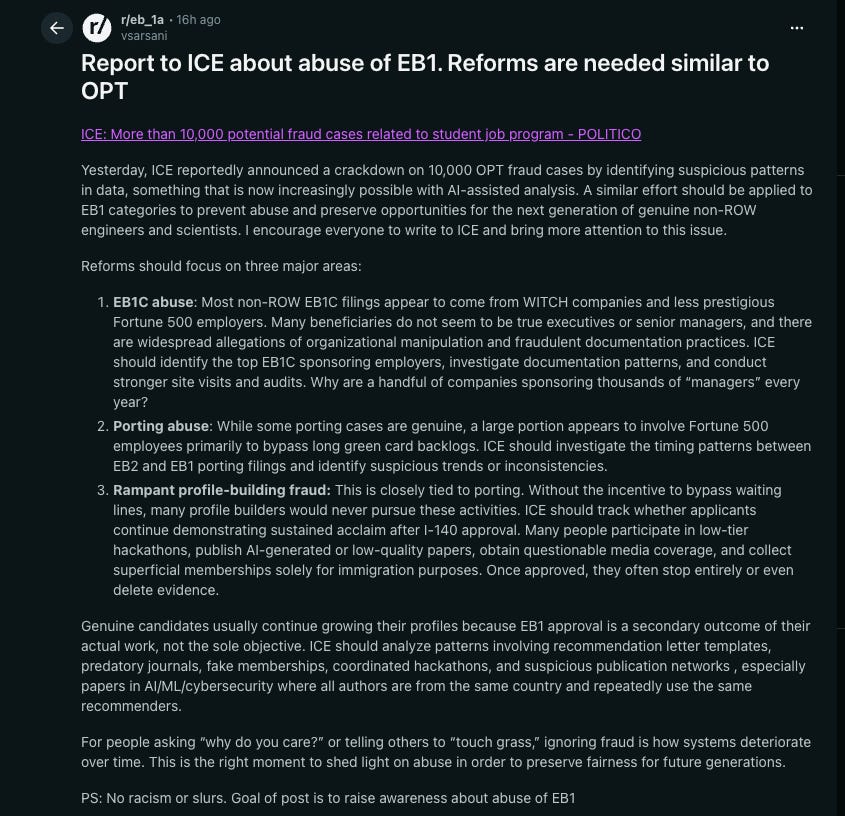
For anyone who has followed employment‑based immigration over the last decade, this should feel familiar. A program that started small, quietly expanded, and then attracted bad actors is now under a harsh spotlight. The uncomfortable truth is that what is now happening to OPT is almost certainly going to happen to EB‑1, especially EB‑1C, unless there are serious reforms.
What ICE actually said about OPT
The numbers alone are striking. ICE says its investigators have identified over 10,000 foreign students connected to “suspect employers” in the OPT and STEM OPT programs, and that this figure comes just from the top 25 OPT employers. Lyons described some of these cases as involving “phantom employees” – students who obtained work authorization but never actually showed up at the worksites they claimed as employers.
Investigators also report multiple OPT employers claiming to operate from the same address, with no real business presence at those locations. In some cases, students were being “managed” remotely from overseas, in violation of rules that require U.S. based supervision and training. Federal officials now openly describe the program as a “guest worker pipeline” that has outgrown its original intent and become a vehicle for organized fraud.
At the same time, reputable immigration law firms are warning that the enforcement dragnet is already catching students who thought they were compliant but were steered into questionable arrangements by third‑party “consultants” or small shops posing as employers. The message is clear: even technically innocent students can be collateral damage when a program is treated as structurally unsafe.
Why OPT became a magnet for abuse
OPT was never designed to be a large‑scale guest worker system. It was a training extension, a way for foreign graduates on F‑1 visas to work in the United States for 12 months, or 24 months for certain STEM fields, and then either return home or transition into a properly regulated status like H‑1B. When it launched under the George W. Bush administration, officials expected only a few thousand beneficiaries.
Instead, as U.S. universities recruited more international students and H‑1B numbers remained capped, OPT effectively turned into a shadow work visa. Employers learned they could hire graduates without paying certain payroll taxes and with fewer compliance obligations than traditional temporary worker programs. A cottage industry of so‑called “consulting” companies emerged whose real product was not training but paperwork: letters, offer sheets, and made‑for‑USCIS documentation designed to show that students had qualifying employment.
Once a system grows faster than its guardrails, the fraud gap opens. That is where we are now. ICE’s investigations have uncovered national and international networks that, in Lyons’s words, amount to “organized fraud that spans national and international borders.” The optics of 10,000 suspected cases make the political reaction inevitable.
The EB‑1 system has many of the same warning signs
If you work in immigration or know people who have been through the EB‑1 process, especially EB‑1C, you have probably seen the same structural weaknesses play out in a different form:
Concentration in a small set of employers
A very small number of companies are responsible for a disproportionate share of certain EB‑1 filings, much like the “top 25 OPT employers” pattern ICE is now flagging. When thousands of “managers” or “executives” emerge from a handful of mid‑tier or little known organizations, it raises the same statistical red flags that ultimately triggered the OPT review.Porting and profile‑building as a business model
In EB‑1, “porting” from EB‑2 or EB‑3 priority dates is perfectly legal when done correctly. But we have also seen scenarios where rapid porting, paired with aggressively curated publication records, awards, and memberships, looks less like organic merit and more like a constructed immigration product. This mirrors the way some OPT participants cobbled together nominal contracts and unpaid “internships” to preserve status while waiting for something better.Template‑driven, industrialized evidence
Just as some OPT employers generated boilerplate employment verification and training plans, EB‑1 ecosystems have grown around recommendation letter templates, predatory journals, low‑quality hackathons, and superficial memberships specifically marketed as “EB‑1 friendly.” The result is a stack of paper that appears impressive on its face but collapses under rigorous scrutiny.
None of these issues erase the existence of genuinely extraordinary individuals or legitimately qualified multinational managers. But they do create the exact conditions that lead enforcement agencies, and eventually politicians, to see the entire category as suspect.
What OPT’s trajectory tells us about the future of EB‑1
The OPT story is not mainly about 10,000 cases. It is about how an under‑regulated program expanded until the only plausible response was a high‑profile crackdown. Once a narrative of “magnet for fraud” settles in, it becomes very difficult to reverse, even for innocent participants who followed the rules as they understood them.
The same narrative arc is now starting to appear around EB‑1 in policy circles and online communities:
Program expansion without proportional oversight
Over time, EB‑1 was stretched from a narrow tool for truly exceptional talent and senior corporate leaders into a broader aspirational goal for anyone with a decent professional profile, especially in fields like AI, data science, and cybersecurity. Marketing from consultants and lawyers reframed it from “rare, difficult, and exceptional” to “ambitious but doable with the right strategy.”Visible clusters of abuse
Just as ICE highlighted suspicious addresses and “suspect employers” in OPT, EB‑1 already has visible clusters: certain employers, networks of recommenders, and pipelines out of particular training institutes or “research” outfits whose primary output appears to be immigration‑oriented profiles rather than independent scientific or business impact.Delay, then a sharp pendulum swing
The government often tolerates gray‑zone behavior for a while because the immediate costs of a crackdown are high. Universities, employers, and families are all affected. Then a large‑scale investigation produces a headline number, and the enforcement and regulatory pendulum swings the other way. That is exactly where OPT is today and where EB‑1 may be heading.
If we care about preserving EB‑1 for truly meritorious candidates, we should not wait for the first “10,000 suspect EB‑1 cases” headline to land.
What reform could look like
Learning from OPT, serious EB‑1 reforms should focus on structure rather than just harsher outcomes for individual applicants:
Employer‑level scrutiny and audits
Just as ICE is now scrutinizing the top OPT employers, USCIS and DHS should identify high‑volume EB‑1 employers and subject them to deeper audits, site visits, and pattern analysis. A handful of companies generating hundreds or thousands of “executive” or “manager” filings per year should have to show actual organizational depth and commercial reality.Evidence quality, not just quantity
USCIS should prioritize whether evidence demonstrates sustained, independent recognition and responsibility, not whether an applicant can assemble a long checklist of marginal publications, talks, or low‑impact awards. That might mean discounting pay‑to‑publish journals, invitation‑only “reviewer” roles that anyone can obtain, and memberships with no meaningful selection criteria.Clearer lines on profile engineering
The system should explicitly address practices whose sole purpose is to manufacture the appearance of extraordinary ability. For instance, where all recommenders are from the same small network, or where every publication is co‑authored with the same small group in low‑impact venues, officers should be empowered to treat this as negative evidence rather than merely weak positive evidence.Transparency and feedback loops
OPT’s current crisis is worsened by the fact that students and smaller employers lacked clear, practical guidance about where the red lines were. For EB‑1, the agencies should publish de‑identified case studies, trend data, and common patterns of denial or suspected fraud. Honest applicants and their counsel need to know not only the law but the lived enforcement reality.
Genuine talent is harmed when fraud is ignored
One of the more painful aspects of the OPT crackdown is that it will hurt exactly the people the program was supposed to help: serious students who came to the United States, studied hard, followed their school’s guidance, and accepted what appeared to be legitimate training opportunities. Many now find themselves under suspicion or facing disruption because the system allowed too much fraud to accumulate for too long.
EB‑1 risks the same fate. When every other LinkedIn profile reads “extraordinary ability” and every mid‑level manager is suddenly an “executive,” genuine outliers lose signal. Their achievements get buried in a sea of engineered résumés and manufactured citations. Over time, public trust collapses, officers become more skeptical, and truly strong cases get stuck in a system designed to filter out abusers.
If we want the United States to remain a magnet for real talent, we have to show that we can distinguish between aspiration and fabrication, between honest ambition and systemic gaming.
A call for serious, not xenophobic, reform
There is a real risk that the OPT story will be weaponized purely for anti‑immigrant politics. That would be a tragedy, both for the thousands of good‑faith students now caught in the middle and for the broader project of keeping the United States open to global talent.
The better path is harder: acknowledge the depth of abuse, insist on structural reforms, and defend the legitimacy of employment‑based immigration when it works as intended. That means supporting targeted enforcement against fraudulent employers and networks while also demanding due process, clear communication, and realistic transition paths for individuals who relied on the system as it was presented to them.
The OPT crackdown is a warning shot. EB‑1 is on a similar trajectory. If we ignore the parallels, we should not be surprised when the next “10,000 cases” press conference is about the green card categories that many of us care about most.