

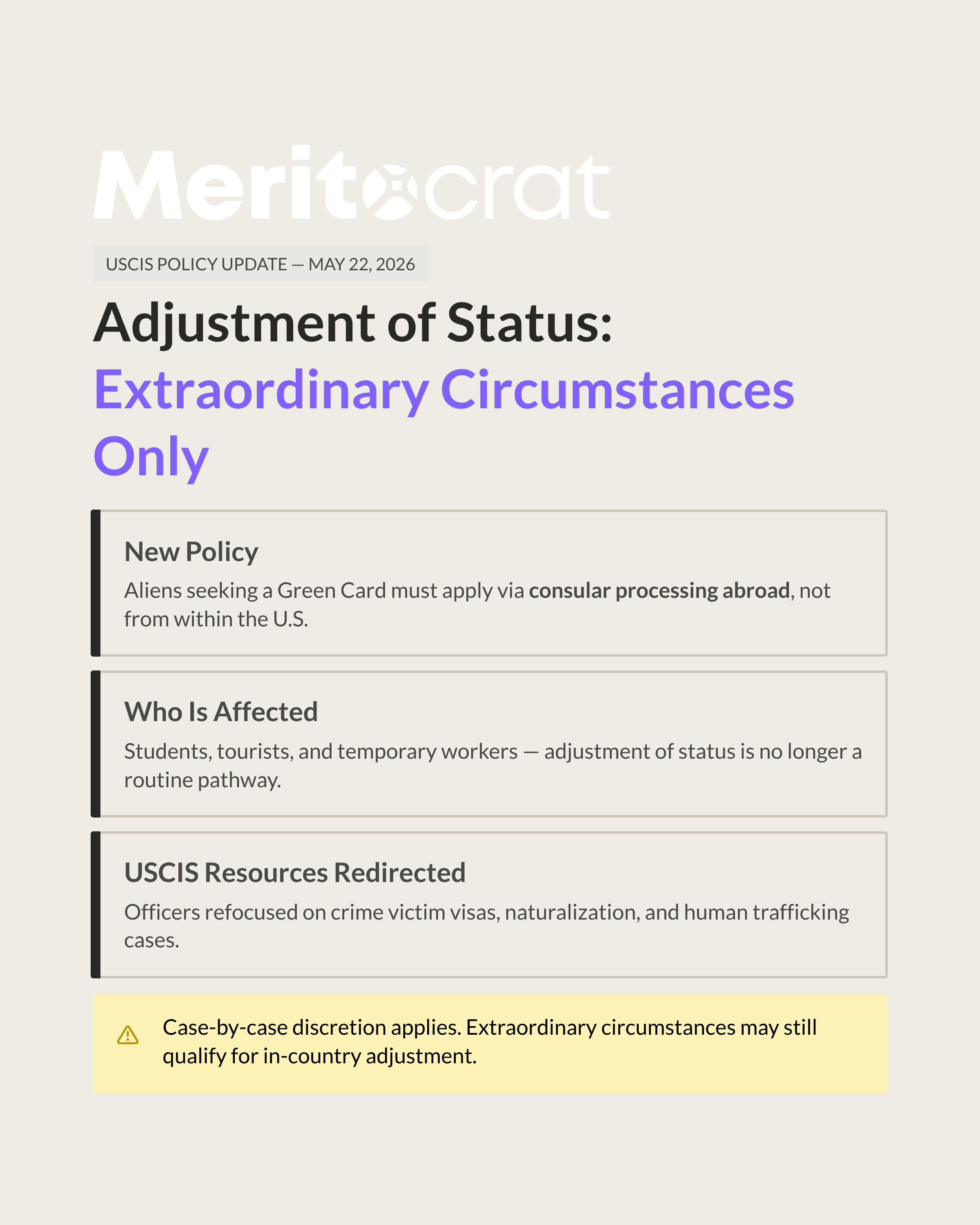
But it does not affect all visa categories in the same way.
What dual intent protects
Dual intent means a person can hold a temporary visa status while also planning to become a permanent resident.
For example, an H-1B worker can:
work temporarily in the U.S.
have an approved I-140
wait for a priority date
file Adjustment of Status when eligible
That green card intent alone should not be treated as a negative factor.
So for H-1B, the issue is usually not:
“Did this person intend to immigrate?”
Because H-1B already allows that.
What dual intent does not protect
Dual intent does not protect someone from other discretionary concerns.
USCIS can still review whether the applicant:
maintained lawful H-1B status
worked only for authorized employers
avoided unauthorized employment
followed the terms of the H-1B petition
avoided status gaps or unlawful presence
avoided fraud, false statements, or misrepresentation
has positive factors that support approval
So the better way to say it is:
Dual intent protects immigrant intent.
It does not protect immigration violations.
How this affects H-1B
H-1B applicants may still be affected because Adjustment of Status remains discretionary.
But they may have fewer concerns than F-1, B-1/B-2, ESTA, or parole-based applicants because their intent to pursue a green card is already allowed.
For H-1B, USCIS may focus more on:
clean immigration history
proper employment authorization
status maintenance
consistency between job, employer, location, and petition
overall positive discretionary factors
How this affects non-dual-intent categories
For F-1, B-1/B-2, ESTA, or similar categories, USCIS may look more closely at whether the person’s conduct was consistent with the purpose of that temporary status.
For example:
Did the person enter as a visitor but quickly pursue permanent residence?
Did the student maintain valid student status?
Did the person work without authorization?
Did the person make representations at visa interview or entry that conflict with later conduct?
These categories may face more questions because immigrant intent is traditionally more sensitive.
Simple conclusion
The memo does not remove Adjustment of Status for H-1B applicants.
But it makes clear that USCIS may look beyond eligibility and examine discretion.
For dual-intent categories like H-1B:
The green card intent itself is usually not the problem.
The real question is whether the person maintained clean status, followed the rules, and presents enough positive factors for USCIS to approve adjustment as a favorable exercise of discretion.