

To ensure clients are protected, lawyers using generative artificial intelligence tools must fully consider their applicable ethical obligations, including their duties to provide competent legal representation, to protect client information, to communicate with clients, to supervise their employees and agents, to advance only meritorious claims and contentions, to ensure candor toward the tribunal, and to charge reasonable fees.
Standing Committee on Ethics and Professional Responsibility

What Generative AI Tools Should Follow for Compliance
ABA Formal Opinion 512 outlines six major compliance areas every legal-tech product must support when attorneys use AI. These are the standards you should design Legal softwares around:
1. Competence
Attorneys must understand the benefits, risks, limitations, and accuracy of any AI tool they use.
• AI output must be verified
• No blind reliance
• AI cannot replace attorney judgment
2. Confidentiality
Lawyers must protect client information and understand how your platform stores, processes, or learns from data.
• No self-learning that exposes one client’s data to another
• Clear data boundaries
• Reading and honoring Terms of Use and data policies
• Some uses require informed consent if AI ingests representation-related data
3. Client Communication
If AI affects cost, process, strategy, or major decisions, attorneys must disclose its use.
• Especially important if AI output influences key choices
• Attorneys must guide clients with independent judgment
4. Meritorious Claims, Candor, and Litigation Integrity
Any AI-generated content used in filings must be:
• Factually correct
• Supported
• Fully reviewed
No hallucinated citations or misstatements.
5. Supervisory Responsibilities
Law firms must train and supervise:
• Lawyers
• Paralegals
• Anyone using the AI
And ensure third-party providers meet confidentiality and security standards.
6. Reasonable Fees
Attorneys must charge fairly when AI speeds up work.
• No billing inflated time
• AI usage fees must be reasonable
• No hidden surcharges
How Meritocrat Platform Aligns With ABA Compliance
Below is your positioning statement showing exactly how Meritocrat meets each requirement.
1. Competence Alignment
Meritocrat is built around binary weighted questions and structured evidence mapping, which helps attorneys exercise judgment rather than outsource it.
• No auto-generated legal conclusions
• All outputs require attorney review
• Transparent scoring and context instead of opaque answers
This keeps attorneys fully in control.
2. Confidentiality Alignment
Meritocrat follows a non-self-learning architecture where:
• Client data never trains shared models
• User data is siloed
• Evidence stays isolated in each workspace
• No cross-client mixing
This reduces the confidentiality risks highlighted in the opinion.
3. Communication Alignment
Meritocrat lets firms clearly disclose:
• How evidence is mapped
• How merit scoring works
• What AI is used for
• How outputs should be reviewed
This helps attorneys meet Rule 1.4 duties for client communication.
4. Meritorious Claims & Candor Alignment
Meritocrat does not create court submissions by itself.
• Attorneys interpret results
• Evidence mapping is transparent
• No hallucinated citations
This removes many litigation risks described in ABA 512.
5. Supervisory Alignment
Meritocrat supports firm-level controls:
• Role-based access
• Audit logs
• Evidence traceability
• Configurable attorney oversight
This aligns with supervisory responsibilities under Rules 5.1 and 5.3.
6. Reasonable Fees Alignment
Meritocrat helps attorneys:
• Document time saved
• Show efficiency gains
• Avoid double-billing
• Distinguish platform cost vs. attorney time
Exactly what ABA requires when AI reduces workload.
Summary: At What Level Does Meritocrat Follow ABA Compliance?
Meritocrat aligns with ABA Formal Opinion 512 at the following levels:
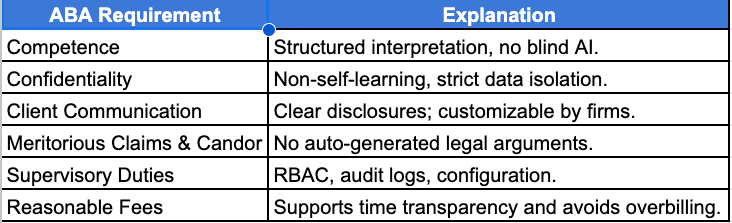
Overall: Meritocrat is designed to meet ABA’s responsible AI use expectations at a very high standard.