

Meritocrat: Keeping Legal Judgment with Attorneys While AI Organizes Evidence
Meritocrat: AI-Organized Legal Merit Workspace
Meritocrat is a legal merit evaluation intelligent workspace for evidence-based immigration. The focus is intentionally narrow: the pre-filing stage for high-stakes immigration categories such as EB-1A, EB-2 NIW, and O-1A.
At this stage, we are not asking whether AI can replace legal judgment. It cannot, and it should not. The more important question is this:
How can AI organize context and evidence while attorneys retain full legal judgment, strategy, and filing control?
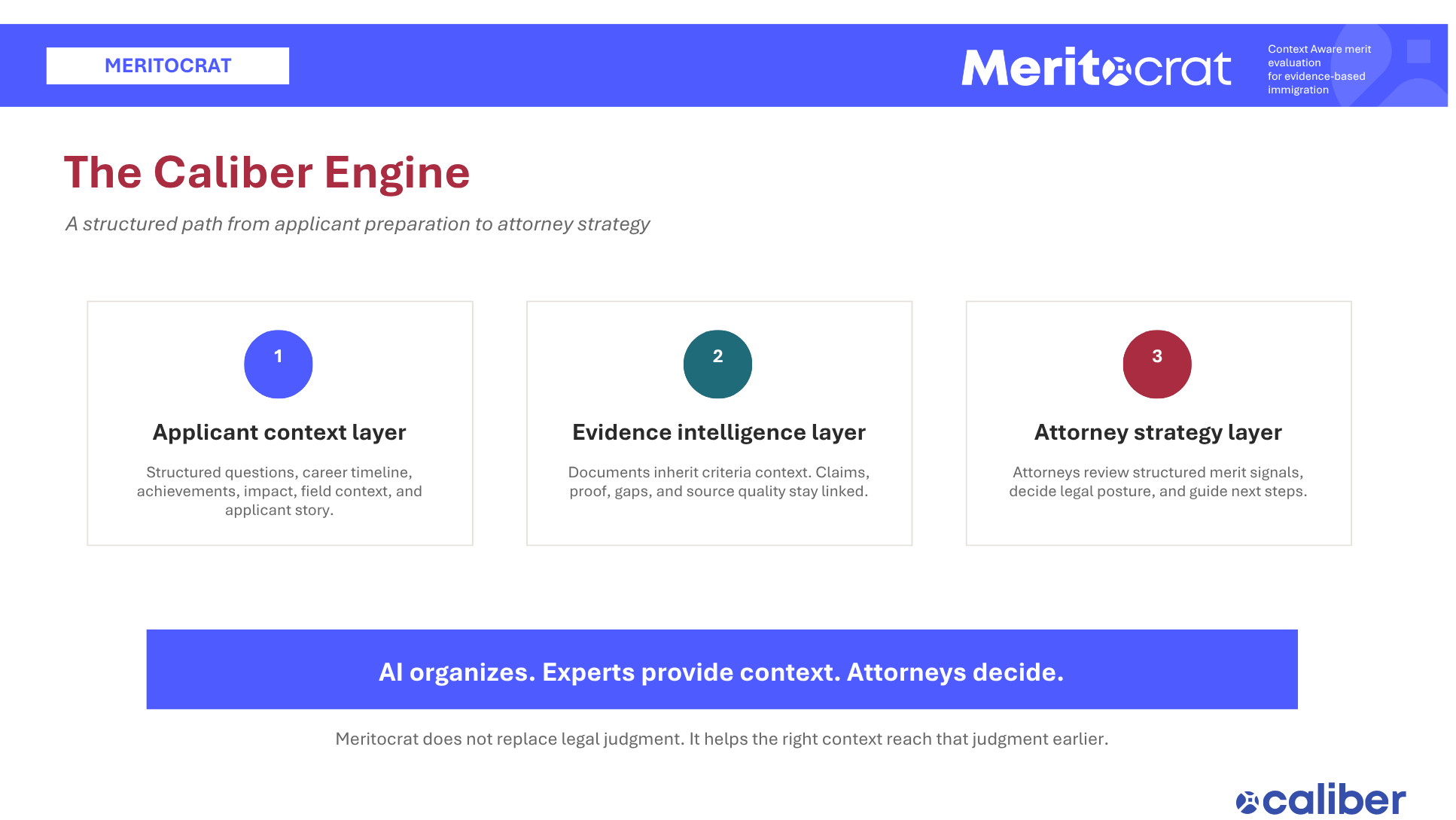
Everything in Meritocrat is built around that boundary. The platform is designed around three layers:
The applicant context layer
The evidence intelligence layer
The attorney strategy layer
Together, these layers help transform scattered applicant information into structured, attorney-reviewable merit signals.
Why the Pre-Filing Stage Matters
The pre-filing stage is the front door of the case. It is where merit is either clarified or lost before drafting begins.
Strong applicants often come with meaningful achievements, but their evidence is scattered across resumes, publications, media mentions, roles, awards, patents, recommendation letters, and other proof of impact. None of that usually arrives as structured merit. It arrives as files, links, memories, and disconnected claims.
Because of this, attorneys and their teams spend significant early time reconstructing the applicant’s story. They rebuild the career timeline, understand field impact, assess the strength of evidence, and map facts to legal criteria. At the same time, applicants often overestimate weak signals or underestimate what is actually strong.
We chose EB-1A, EB-2 NIW, and O-1A intentionally. These categories are evidence-heavy, follow repeatable criteria patterns, and require information from many different sources. The criteria may be defined, but the meaning of the evidence depends entirely on the applicant’s profile, field, impact, and legal positioning.
That is where Meritocrat fits.
The system does not decide eligibility. It does not give legal advice. It does not replace the attorney’s role. Its purpose is to help turn raw evidence into structured merit signals that attorneys can review.
From Raw Evidence to Attorney-Reviewable Context
A typical applicant may begin preparing for an EB-1A, EB-2 NIW, or O-1A petition with achievements spread across documents, links, and memory. Before legal strategy can begin, the attorney needs several things: field context, indicators of impact, evidence tied to criteria, source trust, and early risk flags.
In that reality, the central question is not simply, “Can AI draft a petition?”
The better question is:
Is this case ready for legal strategy?
Meritocrat takes applicant preparation and converts it into attorney-reviewable context that travels with the case. Instead of receiving a random pile of files, the attorney sees a structured profile of the matter.
The goal is not automation for its own sake. The goal is better preparation before attorney judgment is applied.
Designing with an Audit Lens
Meritocrat is designed with an audit lens. That comes from my background in auditing complex enterprise architectures. In legal workflows, the audit is about liability, responsibility, and professional boundaries.
The key questions are:
Who initiates the process?
Who performs intake?
Who reviews the workflow?
What can be delegated to staff or systems?
What must remain with licensed counsel?
Where is legal judgment applied?
In a normal business system, if this mapping fails, the process can usually be corrected. In immigration, the outcome affects a person’s life. That means accountability has to be designed into the system from the beginning.
One of the root causes we see is the absence of structured metadata around evidence. Facts arrive without context. Applicants are confused. Attorneys are pulled into cleanup before they can focus on strategy.
Meritocrat is built to reduce that early disorder.
Gauge: Identifying the Right Jobs for AI
The next step is what we call gauge. This is where we define the business outcomes and jobs to be done, then assess them by impact, repeatability, and suitability for AI.
For example, organizing evidence earlier is highly impactful and highly repeatable. Surfacing an initial fit across EB-1A, EB-2 NIW, and O-1A criteria is also repeatable. Mapping documents and achievements to criteria is an area where AI can assist.
The outcome we want is simple:
Applicants should understand what is missing before they reach the attorney, and attorneys should receive structured merit signals instead of unlabelled files.
That creates a clearer pre-filing roadmap before drafting begins.
Engineer: AI as an Organizing Actor, Not a Decision Maker
The next stage is engineer, where we redesign the workflow with AI as an organizing actor, not a legal decision maker.
At entry, the applicant begins with guided preparation rather than a blank upload portal. They answer structured questions, build a career timeline, and provide context around achievements, impact, and evidence.
Meritocrat’s intake layer orchestrates this process. It manages sequence, context capture, and evidence organization.
A merit signal analyst component helps identify themes such as originality, impact, leadership, acclaim, and field relevance. The evidence organizer then ensures documents inherit criteria context and evaluation metadata.
That means a publication is not just a PDF. It becomes a claim linked to a criterion, linked to proof, linked to impact.
All of this rolls up into an attorney-ready roadmap: a structured portfolio, a criteria map, and clear next steps.
The attorney still decides the legal posture. But the preparation work is no longer scattered across memory, inboxes, loose notes, or disconnected files. It becomes structured.
Navigate: Defining Where Autonomy Stops
The next layer is navigate, where we define where AI autonomy stops.
AI can structure facts and evidence. It can organize a profile against defined criteria. It can categorize documents into criteria folders. It can surface missing context, weak proof, duplication, and gaps. It can generate working summaries for attorney review and organize research notes.
But every visa strategy decision and every filing readiness decision must remain human-led.
The attorney decides which path to pursue. The attorney decides whether the case is strong enough to move forward. The attorney decides the legal theory, risk posture, and final strategy.
Meritocrat is designed around the unauthorized practice of law boundary. The system does not pronounce eligibility. It does not give legal advice. It does not replace attorney reasoning.
Some evidence still requires provenance checks, completeness review, and deeper field context. Those areas remain governed by attorney review protocols.
The important design principle is that human review is built into the workflow from the beginning, not added at the end.
Track: Measuring Whether the Workflow Helps
The final layer is track. This is where we measure whether the system actually improves the pre-filing workflow.
We treat the platform as a set of hypotheses to test through pilot use.
For example:
Does the attorney’s first legal review begin with clearer context and a criteria map?
Do fewer applicants drop out before providing useful case information?
Does evidence mapping become more consistent?
Does attorney time shift from evidence cleanup toward legal strategy?
To make this measurable, Meritocrat includes infrastructure for session logging, case timestamps, decision logging, and attorney audit samples. This allows the firm to see how the tool behaves, where it helps, and where the workflow should be adjusted.
The Three Context Layers of Meritocrat
To bring this back to the product architecture, Meritocrat is built around three context layers.
The first is the applicant context layer. This is where the system collects structured questions, career timeline, achievements, field context, impact, and the applicant’s story.
The second is the evidence intelligence layer. This is where documents inherit criteria context. Claims, proof, gaps, and source quality stay linked instead of living in separate silos.
The third is the attorney strategy layer. This is where the attorney reviews structured merit signals, decides legal posture, and guides the next steps.
The principle is straightforward:
AI organizes. Experts provide context. Attorneys decide.
Meritocrat does not replace legal judgment. It helps the right context and the right evidence reach that judgment earlier, in a more structured and usable form.
I would really value your feedback on two areas.
First, in your practice, where would this kind of structured preparation save the most time?
Second, are there parts of this boundary where you would want us to be even more conservative?